

Why Projects Fail Before Financing
The distance between a compelling infrastructure project and a bankable one – and why it decides almost everything that follows Across the infrastructure sector in Africa, a particular kind…
The African Catalyst · 27 Jul 2026 · 11 min read
The distance between a compelling infrastructure project and a bankable one – and why it decides almost everything that follows
Across the infrastructure sector in Africa, a particular kind of conversation repeats itself with striking regularity. A sponsor has spent years – often three, four, sometimes longer – developing a project. Land has been secured. Feasibility studies have been commissioned. Regulatory approvals have been pursued, sometimes obtained. Preliminary conversations have been held with potential offtakers, contractors, and occasionally with financiers. By any reasonable definition, a great deal of real work has gone into this project.
And yet, when that project is finally presented to an investment committee at a development finance institution, an infrastructure fund, or a commercial bank’s project finance desk, the outcome is rarely a clean yes or no. More often, it is silence – a request for more information, a meeting that is never scheduled, a process that quietly stalls without a clear explanation. The sponsor is left holding a project that feels, by every internal measure, ready – and an investor community that does not appear to agree, without ever quite saying why.
This article is about that gap. It is, in our experience advising sponsors and engaging with financiers across the continent’s infrastructure ecosystem, the single most consequential and least understood obstacle standing between Africa’s enormous infrastructure need and the capital that exists to help meet it.
A Project Is Not the Same Thing as a Bankable Project
The confusion begins with language. Sponsors, quite reasonably, describe what they are building as a “project” – a power plant, a toll road, a hospital, a processing facility, a water treatment works. And in a narrow, technical sense, that is correct. There is a site. There is an engineering concept. There is, frequently, a persuasive rationale rooted in genuine need: the power deficit the project will close, the trade corridor it will unblock, the patients it will treat, the jobs it will create.
None of this is in dispute, and none of it is trivial. Identifying a real infrastructure need and translating it into a concrete development concept is difficult, capital-intensive work, and the sponsors who do it are performing an essential function in the economies they operate in.
But a project, understood this way, is not what an investment committee is evaluating when it reviews a proposal. An investment committee is evaluating a bankable project – a materially different and considerably narrower construct. A bankable project is one where the commercial structure, the risk allocation, the financial model, the sponsor’s own capability, and the surrounding documentation have been assembled to a standard that allows an institution to commit capital against it, on terms its own governance and fiduciary obligations require.
The distinction is not cosmetic. A project can have an excellent rationale, a technically sound design, and a genuinely committed sponsor, and still be, in its current form, entirely unbankable – not because the underlying need or asset is flawed, but because the surrounding structure that would allow an investor to say yes has not yet been built. This is what we refer to as the bankability gap: the distance between a project as its sponsor understands it, and a bankable project as an investment committee is trained to recognise one.
How an Investment Commitee Actually Reads A Project
It is worth being specific about what changes when a project idea crosses the desk of an institutional investor, because the shift in perspective is where most of the confusion originates.
A sponsor, having lived with a project for years, evaluates it largely through the lens of its development narrative – how far it has come, how much effort it represents, how compelling its underlying case is. An investment committee, by contrast, is a professional risk allocation function. Its members are not being asked whether the project is a good idea. Infrastructure deficits across African markets are, in the overwhelming majority of sectors, well documented and not seriously contested. They are being asked a narrower and more mechanical question: can this specific structure, as presented, be relied upon to generate the cash flows required to service the capital being requested, across the specific risks this asset and this market present, for the specific duration involved?
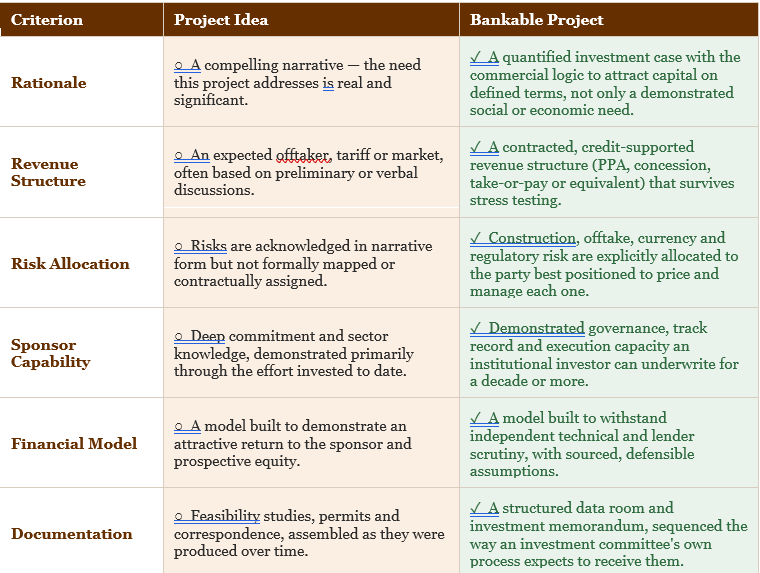
That question breaks down into a fairly consistent set of sub-questions across institutions, sectors and geographies. Is the sponsor, based on track record, governance and team, capable of executing a transaction of this scale and complexity? Is the revenue structure – a power purchase agreement, a concession, a regulated tariff, an offtake contract, or open market exposure – clearly defined and adequately secured? Has each major risk in the project – construction, operating, currency, regulatory, offtake – been allocated to the party best positioned to price and manage it, rather than left, by default, sitting with the sponsor? Would the financial model survive scrutiny from an independent technical adviser or lender’s engineer, rather than simply presenting an attractive return to the sponsor’s own equity? And is there a complete, well-sequenced set of documentation – a data room, an investment memorandum, a realistic development roadmap – that allows the institution’s own internal process to move forward efficiently?
A project can score highly against the first, informal set of criteria – the ones a sponsor naturally applies – and score considerably lower against the second, formal set that governs an actual investment decision. That mismatch, more than weak fundamentals, macroeconomic conditions, or even capital scarcity, is what causes so many technically sound African infrastructure projects to stall before they ever reach financial close.
Capital Is Not The Binding Constraint
It is worth confronting directly a assumption that shapes how many sponsors think about their own challenge: the belief that the primary obstacle to financing African infrastructure is a shortage of available capital.
This does not, in our experience, match the evidence on the ground. Development finance institutions, infrastructure-dedicated funds, pension funds seeking long-duration assets, and a growing number of family offices have, collectively, allocated substantial capital specifically earmarked for African infrastructure. The public statements, strategic plans and mandates of institutions across the DFI and infrastructure fund landscape consistently describe pipelines of capital seeking deployment that outstrip the supply of projects structured well enough to absorb it. The persistent complaint from the investor side of the table is rarely “there is nothing to invest in” – it is “we cannot find enough bankable opportunities to deploy the capital we already have.”
This reframes the challenge considerably. If capital were the binding constraint, the appropriate response would be advocacy – lobbying for larger allocations, new funds, expanded mandates. Useful as that advocacy may be for other reasons, it does not address the actual bottleneck most sponsors face. The binding constraint, in the overwhelming majority of cases we observe, is the supply of investment-ready projects – projects that have closed the bankability gap sufficiently for existing, available capital to move.
This is, in a real sense, encouraging news, though it rarely feels that way to a sponsor mid-way through a stalled financing process. A shortage of investable projects is a solvable problem, and it is solvable largely through the sponsor’s own effort, in a way that a genuine shortage of capital would not be.
Why The Gap Persists
If the bankability gap is, in principle, closable through disciplined preparation, it is fair to ask why it persists as widely and as stubbornly as it does across the sector. In our experience, a handful of structural reasons recur.
The first is a mismatch of expertise. The skills required to develop an infrastructure project – securing land and permits, navigating local regulatory relationships, managing community and stakeholder engagement, coordinating technical design – are substantially different from the skills required to structure that project for institutional investment. A sponsor who has spent a career developing projects is not, by virtue of that experience, equipped to build a bankable financial model, design a defensible risk allocation matrix, or construct an investment memorandum in the sequence an investment committee expects to read one. These are specialised, learnable skills, but they are not automatically acquired through project development experience, however extensive.
The second is the absence, in many markets, of a strong intermediary ecosystem of transaction advisers who work specifically at the early stage. Larger, later-stage transactions attract the attention of established investment banks and advisory firms. Early-stage projects – precisely the ones that most need structuring support to become investable – often cannot afford, or cannot access, comparable advisory capacity. This leaves many sponsors self-taught in project finance discipline, learning through a series of costly, informal trial-and-error cycles with investors, rather than through structured guidance before those conversations begin.
The third is a natural but costly sequencing error. Sponsors, understandably focused on keeping a project alive against considerable odds, tend to defer investment readiness work until financing feels imminent – reasoning that governance, documentation and financial model rigor can be addressed “once we’re closer to actually raising.” In practice, this treats investment readiness as a late-stage formality rather than what it actually is: foundational work that determines how efficiently, and on what terms, a financing conversation proceeds. By the time it becomes urgent, in the middle of a live process, there is often far less time and far less flexibility to do it well.
The fourth, more subtle reason is that gaps in one’s own project are genuinely difficult to see from the inside. A sponsor’s attention naturally gravitates toward the parts of a project that are furthest along and most visible – the technical design, the site, the relationships built over years. The parts an investor will scrutinise hardest – governance structure, documentation completeness, the robustness of underlying assumptions in a financial model – are often exactly the parts a sponsor has had the least outside reason to examine critically. This is not a failure of diligence; it is simply what happens when the same person is both the builder and the ultimate judge of a project’s own readiness.
Project Idea vs Bankable Project
The table below sets out the same six criteria in both forms – as a sponsor typically frames them while developing a project, and as an investment committee actually needs to see them before it can act. It is a useful exercise to read your own project against both columns honestly, criterion by criterion, before your next investor conversation rather than during it.
Closing The Gap Is A Sequence, Not An Event
It follows from all of this that closing the bankability gap is not a single action a sponsor takes once, shortly before approaching investors. It is a body of disciplined, sequenced work – spanning commercial structuring, financial modelling, governance design, risk allocation and documentation – that is far more effective, and considerably less costly, when undertaken deliberately before capital is sought, rather than reactively in response to a stalled or declined financing conversation.
This has a practical implication worth sitting with. The right moment to begin investment readiness work is not when a term sheet is imminent, or after a financing conversation has stalled without clear feedback. It is earlier – while a project still has the runway to address what a rigorous, external diagnostic would reveal, and while adjustments to structure, governance or documentation remain relatively inexpensive to make.
The projects that move efficiently from concept to financial close are, almost without exception, not the ones with the most compelling rationale or the most advanced technical design in isolation. They are the ones where a sponsor, at some point, made the deliberate decision to view the project the way an outside investment committee would – and did the disciplined, occasionally uncomfortable work of closing the gaps that view revealed, before an actual investment committee ever had the chance to find them independently.
That discipline is, in the end, substantially within a sponsor’s own control. Unlike currency volatility, regulatory reform, or the broader macroeconomic environment, the bankability gap does not require anyone else’s permission to close. It requires a clear-eyed diagnosis of where a specific project currently stands, and a sequenced plan to move it – deliberately, and well before the next investor conversation – toward the standard an investment committee is actually trained to recognise as ready.
Key Takeaways
- A compelling infrastructure project and a bankable one are not the same thing.
- Capital is not the binding constraint for African infrastructure; investable, well-structured projects are.
- The bankability gap is closed through disciplined preparation before financing conversations begin, not during them.
Keep reading Knowledge Hub
Related insights
Insights
Understanding ESIIR
A closer look at the Early Stage Infrastructure Investment Readiness programme — what it is, how it is sequenced, and why the sequence itself is the point It is…
27 Jul 2026 · 8 min read
Insights
From Stalled to Structured
A hypothetical case study illustrating how the ESIIR framework converts an unexplained stalled financing process into structured addressable path to investment readiness. The Project Kestrel Power Partners is…
27 Jul 2026 · 10 min read
Insights
How Investors Evaluate Early-Stage Infrastructure Projects
A practical walk-through of the five filters development finance institutions and infrastructure investors apply – and the questions each one raises about your project. Most sponsors, preparing to approach an…
27 Jul 2026 · 11 min read
Insights
The Real Cost of Infrastructure Investment Delay
Why treating investment readiness as a later-stage formality is rarely the neutral, low-risk choice it feels like at the time. “We’ll tighten up the governance and the financial model…
27 Jul 2026 · 8 min read