

The Real Cost of Infrastructure Investment Delay
Why treating investment readiness as a later-stage formality is rarely the neutral, low-risk choice it feels like at the time. “We’ll tighten up the governance and the financial model…
The African Catalyst · 27 Jul 2026 · 8 min read
Why treating investment readiness as a later-stage formality is rarely the neutral, low-risk choice it feels like at the time.
“We’ll tighten up the governance and the financial model once we’re closer to actually raising capital.” It is one of the more common sentences we hear from infrastructure sponsors in early conversations, and it rarely reflects poor judgment. It reflects a reasonable instinct to direct scarce time and resources toward what feels most urgent in the moment – securing land, advancing permits, negotiating offtake – and to defer what feels like it can wait.
The difficulty with this instinct is that investment readiness does not compress well under time pressure, and the cost of treating it as a later-stage task is rarely visible until a sponsor is already inside a live financing process – and discovers, often through a term sheet that stalls or a due diligence process that drags on for months without resolution, that the work cannot simply be accelerated to meet the moment.
This guide sets out three specific, recurring costs that accumulate quietly during a delay in investment readiness preparation. None of them are hypothetical; each reflects a pattern we have observed repeatedly across sectors and sponsors. Understanding them is less about manufacturing urgency than about making an argument we believe is chronically under-made: that investment readiness is early-stage work, not a late-stage formality, and its cost of delay is real even when it is invisible in the moment it is being incurred.
Cost One: Missed Capital Allocation Cycles
Development finance institutions, infrastructure funds and development banks do not deploy capital continuously and evenly across time. They operate through allocation cycles – annual or multi-year planning periods, sector and geographic priorities that shift with institutional strategy, and pipeline review processes that occur on fixed internal schedules rather than in response to any individual sponsor’s timeline.
This has a specific and often underappreciated consequence. A project that is investment-ready at the moment a relevant allocation window opens has an entirely different conversation available to it than an otherwise identical project that is still being structured when that same window closes. The underlying capital may well return in twelve or eighteen months, when the institution’s next cycle begins. But the sponsor’s project has, in the meantime, lost a cycle it cannot recover – and in a competitive pipeline environment, newer, better-prepared projects from other sponsors do not wait politely behind it. They frequently move into the queue ahead of it, simply by virtue of being ready when the window was actually open.
The practical implication is that “we will be ready when we need to be” is a riskier assumption than it sounds, because readiness and timing are only loosely within a sponsor’s control independently – but jointly, they compound. A project prepared six months too late relative to a specific institution’s cycle has not lost six months. It has often lost the better part of two years, once the next available cycle, its own internal review timeline, and the queue of competing projects are accounted for.
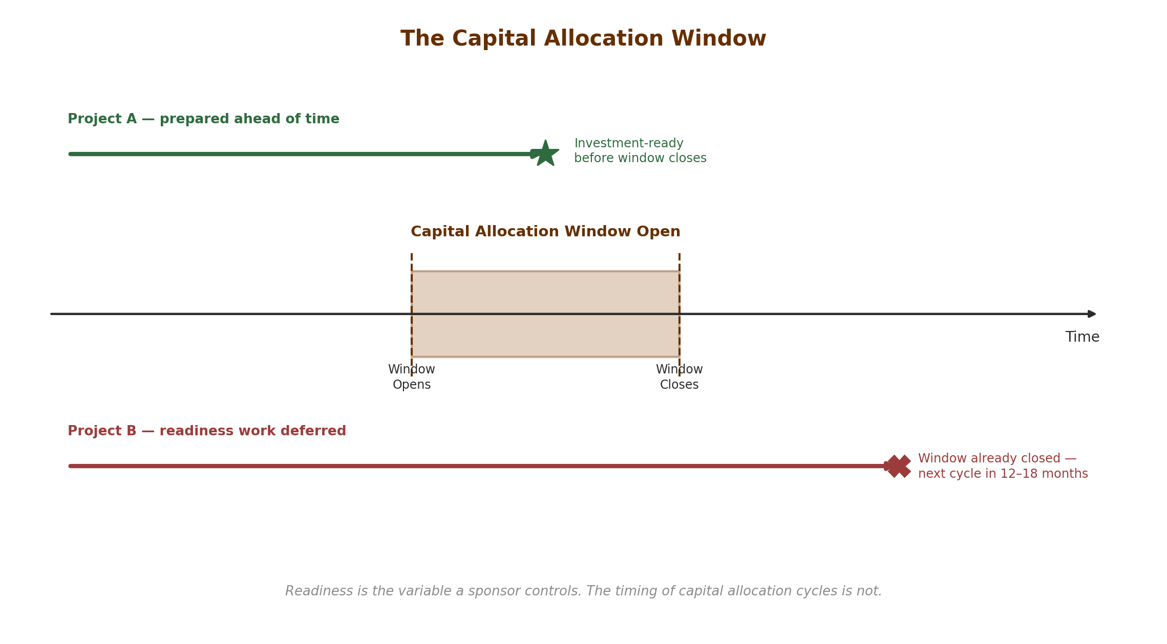
Figure 1 – The Capital Allocation Window. Readiness is the variable a sponsor controls; the timing of institutional capital cycles is not.
Cost Two: Risk That Becomes More Expensive to Resolve Over Time
The second cost compounds in a different, less visible way. A risk left unallocated at an early stage of project development – currency risk on foreign-currency debt serving local-currency revenue is a common example – does not remain a modest, deferred problem waiting patiently to be addressed later. It tends to become considerably more expensive to resolve the closer a project moves toward financial close.
There are two reasons for this. First, the structuring options available to address a risk are generally most flexible and least expensive early, before financing terms, counterparties and contractual relationships have hardened around a particular structure. A hedging arrangement, a partial guarantee, or a contractual pass-through mechanism designed into a project from an early stage is a fundamentally different exercise – in cost, complexity and negotiating leverage – than attempting to retrofit the same protection into a project during late-stage negotiation, when other terms are already largely fixed.
Second, counterparties price in the sponsor’s apparent lack of foresight. An investor or lender who discovers, late in a process, that a material risk has not been addressed does not simply request that it be fixed at no cost to the sponsor. They typically reprice the transaction to reflect both the risk itself and the diminished confidence the discovery creates about what else might have been overlooked. What might have been resolved early through a modest, well-structured mitigation instrument becomes, at a late stage, a renegotiation that erodes sponsor equity, extends timelines by quarters rather than weeks, and in some cases causes counterparties to walk away from a transaction they had previously seemed committed to.
The broader lesson is that risk allocation is not a cost that can simply be deferred without penalty. It is closer to compound interest – modest and manageable if addressed early, and considerably more expensive the longer it is allowed to accrue unaddressed.
Cost Three: Reputational Memory in a Small Ecosystem
The third cost is, in our experience, the most consistently underestimated by sponsors, largely because it operates through channels that are informal and rarely discussed openly. African infrastructure finance, particularly at the early stage, involves a relatively small and tightly networked set of development finance institutions, funds, family offices and advisers – many of whom maintain regular, informal contact with one another, compare notes on pipeline opportunities, and, in some cases, sit on the same deals or co-invest alongside each other repeatedly over time.
A project that reaches an investment committee underprepared, is quietly shelved rather than formally declined, and later resurfaces – whether with the same institution or a different one within the same network – does not arrive at that second conversation with a clean slate. It arrives with a memory attached to it. Sponsors sometimes describe this, informally, as their project having “done the rounds” – a phrase used within investor and advisory circles, not always kindly, to describe deals that have circulated repeatedly without closing, and that carry an implicit caution flag as a result, regardless of what has actually changed about the project in the interim.
This dynamic is rarely stated explicitly to the sponsor’s face, which is precisely what makes it so easy to underestimate. A sponsor may reasonably believe that a second, better-prepared approach to a different institution represents a fresh start. In a genuinely small ecosystem, it frequently does not – the institution’s own diligence process, or a casual conversation between colleagues at different institutions, can surface the project’s earlier, unsuccessful circulation regardless of the sponsor’s own account of events.
Avoiding this outcome in the first instance is considerably easier than repairing it after the fact. It is one of the strongest practical arguments for treating the first serious approach to any investor – or, ideally, the informal soundings that typically precede it – as a moment that deserves the same preparation a sponsor might otherwise reserve for a final, formal financing round.
Urgency Without Recklessness
None of the above is intended to manufacture urgency where none genuinely exists. The urgency in infrastructure development, to the extent it is real, comes from underlying capital cycles, counterparty timelines, and the pace at which competing projects are advancing – not from any external party’s interest in a sponsor moving quickly for its own sake.
It is worth distinguishing clearly between two responses to the costs described above, because they are easily conflated and lead to very different outcomes. The first response – the one we would caution against – is to rush investment readiness work in reaction to a specific, immediate deadline, treating it as a checklist to complete as fast as possible before a looming financing conversation. This tends to produce exactly the kind of superficial preparation that unravels under an investment committee’s actual scrutiny, defeating the purpose entirely.
The second, more productive response is to recognise that investment readiness is foundational, early-stage work – not because any specific deadline demands it today, but because delay carries the compounding costs described above, and because the sponsors who begin this work while a project still has genuine runway are the ones who are, in practice, ready when a real capital allocation window opens, rather than scrambling to catch up with it after the fact.
The distinction, in short, is between urgency as a reason to work carefully starting now, and urgency as a reason to work carelessly later. The first produces investment-ready projects. The second, in our experience, rarely does.
Key Takeaways
- Capital allocation cycles at DFIs and funds are time-bound; unready projects can miss windows that do not simply reopen on demand.
- Unresolved risk allocation becomes more expensive to fix the later it is addressed, not less.
- African infrastructure finance is a relationship-driven ecosystem; projects that circulate unprepared carry that history into future conversations.
Keep reading Knowledge Hub
Related insights
Insights
Understanding ESIIR
A closer look at the Early Stage Infrastructure Investment Readiness programme — what it is, how it is sequenced, and why the sequence itself is the point It is…
27 Jul 2026 · 8 min read
Insights
Why Projects Fail Before Financing
The distance between a compelling infrastructure project and a bankable one – and why it decides almost everything that follows Across the infrastructure sector in Africa, a particular kind…
27 Jul 2026 · 11 min read
Insights
From Stalled to Structured
A hypothetical case study illustrating how the ESIIR framework converts an unexplained stalled financing process into structured addressable path to investment readiness. The Project Kestrel Power Partners is…
27 Jul 2026 · 10 min read
Insights
How Investors Evaluate Early-Stage Infrastructure Projects
A practical walk-through of the five filters development finance institutions and infrastructure investors apply – and the questions each one raises about your project. Most sponsors, preparing to approach an…
27 Jul 2026 · 11 min read