

From Stalled to Structured
A hypothetical case study illustrating how the ESIIR framework converts an unexplained stalled financing process into structured addressable path to investment readiness. The Project Kestrel Power Partners is…
The African Catalyst · 27 Jul 2026 · 10 min read
A hypothetical case study illustrating how the ESIIR framework converts an unexplained stalled financing process into structured addressable path to investment readiness.
The Project
Kestrel Power Partners is a mid-sized independent power developer founded by a team with strong engineering and utility backgrounds but limited prior experience closing project finance transactions. For close to four years, Kestrel had been developing a 60 megawatt hybrid solar-gas power project intended to supply a regional distribution utility in a West African market with a well-documented, persistent power deficit.
By the time this case study picks up, Kestrel had genuinely accomplished a great deal. Land rights were secured. An independent feasibility study had been completed by a respected technical consultancy. Preliminary conversations with the state-linked distribution utility about offtake had been ongoing for over a year, and both sides described the relationship as positive. A financial model had been built in-house by Kestrel’s own finance lead, a capable generalist without specific project finance training. By any internal measure available to the founding team, this was a strong, well-advanced project.
Over the preceding eighteen months, Kestrel had approached three commercial banks and one regional development finance institution. Each conversation had followed a similar pattern: an initial meeting generated genuine interest, a request for additional information followed, Kestrel supplied what was requested as best it could, and then – in every case – the process simply went quiet. No formal decline was ever issued. No institution offered a clear explanation for why momentum had stalled. The founding team was left with a project they believed in, and four increasingly discouraging experiences with an investor community that would not tell them why.
The Wall Of Silence
This pattern – polite interest followed by unexplained silence – is, in our experience, the most common and most disorienting outcome for early-stage sponsors, precisely because it offers nothing concrete to act on. A formal rejection, however unwelcome, at least identifies a specific objection a sponsor can address or contest. Silence identifies nothing. It leaves a sponsor to guess at what went wrong, often defaulting to explanations that feel true but are not necessarily accurate – market conditions, institutional risk appetite, unrelated portfolio constraints – none of which point toward anything the sponsor can actually change.
By the time Kestrel’s founding team engaged with ESIIR, this was precisely their state of mind. They were confident in their project’s fundamentals, mystified by the lack of investor traction, and increasingly concerned that continuing to approach new institutions with the same materials would reproduce the same outcome a fifth and sixth time.
What The Diagonistic Found
ESIIR’s diagnostic phase assesses each participating project against the same five criteria an investment committee would actually apply: sponsor capability, commercial structure, risk allocation, financial model integrity, and documentation. For Kestrel, this diagnostic surfaced three specific, previously invisible gaps – none of them fatal, all of them entirely sufficient, individually or in combination, to explain eighteen months of unexplained silence.
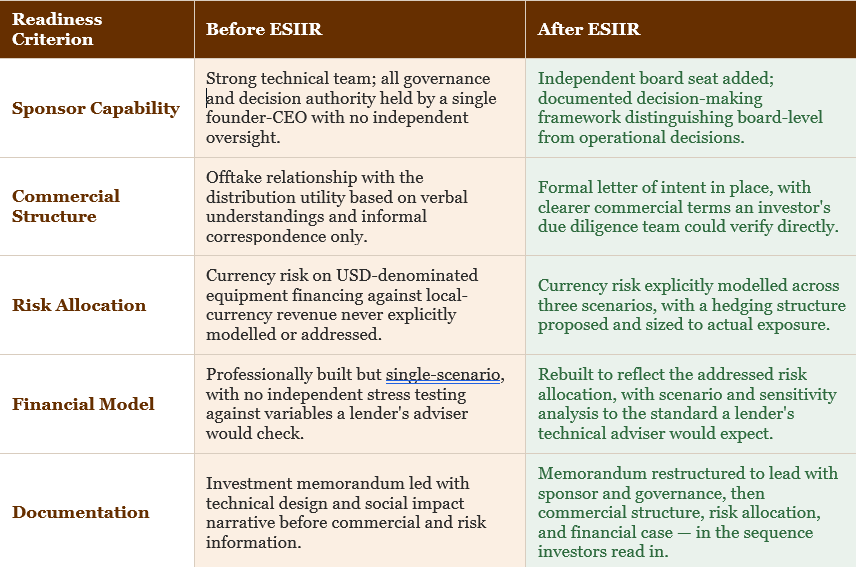
The first was in commercial structure. The offtake relationship with the distribution utility, described internally by Kestrel as “well advanced,” existed entirely through verbal understandings and informal correspondence. No letter of intent, term sheet, or other semi-binding instrument had ever been signed. From an investor’s perspective, this meant the project’s core revenue assumption – the single most important number in the entire financial model – was, in documentary terms, entirely unsupported. An investment committee reviewing this project had no way to verify that the offtake arrangement Kestrel described actually existed on the terms presented.
The second was in the financial model. The model itself was professionally constructed and internally consistent, but it had never been stress-tested for currency risk – despite the project’s equipment financing being denominated in US dollars while its tariff revenue would be paid in local currency. This is one of the first checks any competent lender’s technical adviser performs on a project of this type, and its absence would have been immediately visible to any serious reviewer, even though it had not been visible to Kestrel’s own in-house finance lead, who had built the model without project finance-specific training.
The third was in governance. Kestrel’s decision-making authority rested entirely with its founder-CEO, with no independent board oversight and no documented framework for decisions above a certain threshold. This is an unremarkable, even typical, structure for an early-stage developer, but it is precisely the kind of structure that gives institutional investors pause about succession risk and governance discipline over what would likely be a fifteen-year or longer investment horizon.
None of these three gaps were, individually, disqualifying. Together, they were sufficient to explain – far more precisely than “market conditions” or “risk appetite” ever could – why four separate institutions had each lost momentum at a similar point in their review, without any of them ever articulating a specific reason to Kestrel directly.
The Engagement
Working through ESIIR’s structuring and mentoring element, Kestrel addressed each of the three gaps directly and in parallel over the following several months.
On commercial structure, Kestrel’s team, supported by ESIIR advisers with direct experience in comparable power offtake negotiations, restructured its engagement with the distribution utility toward a formal letter of intent with clearer, more specific commercial terms – using a structuring approach informed by precedents from ESIIR’s power and transport sector work. This did not change the underlying relationship, which had genuinely been constructive throughout, but it converted an informal understanding into a document an investor’s due diligence team could actually review and rely upon.
On the financial model, the model was rebuilt with explicit currency risk modelling across three defined scenarios, alongside a proposed hedging structure sized specifically to the project’s actual foreign-currency exposure – addressing, directly, the exact gap a lender’s technical adviser would otherwise have identified independently, likely late in a live due diligence process, at a considerably less convenient moment for Kestrel.
On governance, Kestrel introduced an independent board seat and a documented decision-making framework distinguishing which categories of decision required board-level sign-off, addressed through the programme’s governance module and direct mentoring support. The founder-CEO remained central to the business, but the project’s governance no longer depended entirely on a single individual’s availability and judgment.
Alongside this structuring work, Kestrel’s investment memorandum was substantially reorganised – not to add new information, but to present the existing project in the sequence an investment committee actually reads in: sponsor and governance credentials first, commercial structure and offtake evidence second, risk allocation third, and the financial case fourth. Kestrel’s original memorandum had led with technical design and social impact, a natural sequence for a team of engineers proud of what they had built, but not the sequence that allows an investment committee to move efficiently through its own internal process.
The Outcome
The change in investor response was significant. Where eighteen months of independent outreach had produced four separate instances of stalled, unexplained silence, the restructured project secured a formal due diligence process with a regional development finance institution within the programme’s cohort period – the same category of institution that had previously gone quiet on an earlier approach, now engaging with a materially different set of materials. Kestrel also presented the restructured project to investors through InfraPitch, generating direct interest from two infrastructure-focused funds that had not previously been aware of the opportunity.
It is important to be precise about what this outcome does, and does not, demonstrate. Readiness work of this kind materially improves the quality, clarity and pace of investor engagement, and in Kestrel’s case was the decisive factor in moving from a pattern of stalled conversations to a structured, active due diligence process. It does not, on its own, guarantee financial close, which continues to depend on negotiation, prevailing market conditions, and elements of any transaction that remain outside any programme’s or sponsor’s direct control. What changed for Kestrel was not the underlying asset – the power project had reasonable fundamentals throughout this entire period, including during the eighteen months when investors said nothing useful about it. What changed was Kestrel’s ability to present that asset in a form an investment committee could actually act on, and the removal of three specific, previously invisible structural gaps that had been generating silence rather than feedback.
Before and After
The table below summarises Kestrel’s status across the five readiness criteria before the ESIIR diagnostic and structuring engagement, and after it. It illustrates the nature of the change involved: not a different project, but the same project, restructured to answer the questions an investment committee actually asks, in the sequence it actually asks them.
What Ilustrates This
Kestrel’s scenario is, in our experience, closer to the rule than the exception among sponsors who reach out to ESIIR after a period of stalled, unexplained investor engagement. Three broader lessons are worth drawing out explicitly, because they apply well beyond this particular hypothetical and beyond the power sector specifically.
The first is that stalled, silent investor conversations are far more often a symptom of specific, addressable structural gaps than a verdict on the underlying project. Kestrel’s power project had genuine merit throughout the entire eighteen-month period in which investors said nothing useful about it. The silence reflected gaps in commercial structure, risk allocation and governance – not a flaw in the underlying rationale for the asset itself.
The second is that diagnosis converts invisible obstacles into specific, addressable issues. Before the ESIIR diagnostic, Kestrel had no concrete explanation for why four separate institutional conversations had each lost momentum. Silence and vague feedback carry no diagnostic information on their own – they simply signal that something, somewhere, did not satisfy an unstated internal threshold. A rigorous, external diagnostic is what converts that non-information into a specific, prioritised, addressable list.
The third, and the one we would ask any sponsor reading this to hold onto most carefully, is that readiness work changes the pace and quality of investor engagement – it does not replace negotiation, market timing, or the elements of a transaction that remain genuinely outside any sponsor’s control. Kestrel’s restructured project moved into formal due diligence considerably faster than its unstructured predecessor had managed in eighteen months of independent effort. That is a materially different, and more valuable, position to be in. It is not, in itself, a guarantee of financial close, which still depends on factors readiness work alone cannot determine. What readiness work reliably delivers is the ability to have the right conversation, on the right terms, with the institutions positioned to act – rather than continuing to generate the same unexplained silence, indefinitely, with a project that may have deserved a better outcome all along.
Key Takeaways
- Stalled, silent investor conversations are usually a symptom of unaddressed structural gaps, not a verdict on the underlying project.
- Diagnosis converts invisible obstacles (silence, vague feedback) into specific, addressable issues.
- Readiness work changes the pace and quality of investor engagement – it does not replace negotiation, market timing, or the elements of a transaction outside any sponsor’s control.
Keep reading Knowledge Hub
Related insights
Insights
Understanding ESIIR
A closer look at the Early Stage Infrastructure Investment Readiness programme — what it is, how it is sequenced, and why the sequence itself is the point It is…
27 Jul 2026 · 8 min read
Insights
Why Projects Fail Before Financing
The distance between a compelling infrastructure project and a bankable one – and why it decides almost everything that follows Across the infrastructure sector in Africa, a particular kind…
27 Jul 2026 · 11 min read
Insights
How Investors Evaluate Early-Stage Infrastructure Projects
A practical walk-through of the five filters development finance institutions and infrastructure investors apply – and the questions each one raises about your project. Most sponsors, preparing to approach an…
27 Jul 2026 · 11 min read
Insights
The Real Cost of Infrastructure Investment Delay
Why treating investment readiness as a later-stage formality is rarely the neutral, low-risk choice it feels like at the time. “We’ll tighten up the governance and the financial model…
27 Jul 2026 · 8 min read