

How Investors Evaluate Early-Stage Infrastructure Projects
A practical walk-through of the five filters development finance institutions and infrastructure investors apply – and the questions each one raises about your project. Most sponsors, preparing to approach an…
The African Catalyst · 27 Jul 2026 · 11 min read
A practical walk-through of the five filters development finance institutions and infrastructure investors apply – and the questions each one raises about your project.
Most sponsors, preparing to approach an investor for the first time, prepare for the wrong audience. They prepare to convince a technical peer – an engineer, a fellow developer, a public sector counterpart who already understands why the project is needed. That preparation is not wasted, but it is incomplete, because an investment committee is a fundamentally different audience, applying a fundamentally different evaluation process.
Investment committees at development finance institutions, infrastructure funds and commercial banks’ project finance desks are, in effect, professional risk allocators. Their process varies in detail from one institution to another, but in our experience advising sponsors across multiple sectors and engaging directly with financiers, it moves through a remarkably consistent sequence of five filters. Understanding that sequence – and, specifically, that it is a sequence, where a weak answer early on can end a review before later filters are ever reached – is one of the highest-leverage things a sponsor can do before their next investor conversation.
This guide walks through each of the five filters in turn: what it is, what investors are specifically looking for, the red flags that most commonly derail a review at that stage, and the questions worth asking of your own project before someone else asks them for you.
The Sequence At Glance
Before examining each filter individually, it helps to see the sequence as a whole. Investment committees generally assess, in order: sponsor capability, commercial structure, risk allocation, the financial model, and finally documentation and process readiness. Each filter, in principle, gates access to the next – a project that raises serious doubt at the sponsor capability stage may never receive a rigorous review of its financial model at all, regardless of how strong that model is.
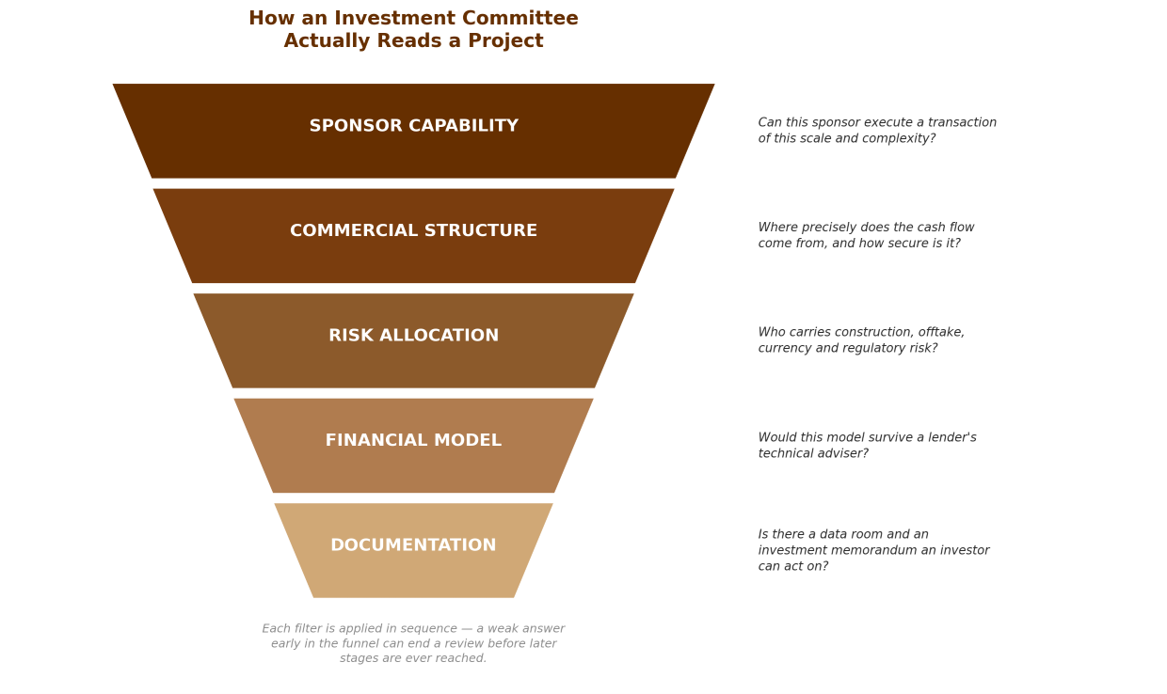
Figure 1 – How an Investment Committee Actually Reads a Project. Each filter is applied in sequence; a weak answer early in the process can end a review before later stages are reached.
Filter One: Sponsor Capability
Before an investment committee examines the substance of a project, it examines who is bringing it. This is not a formality – it is often the single most decisive filter in the entire process, because institutional investors are not simply buying an asset; they are entering a relationship with a sponsor that, for infrastructure, frequently runs ten, fifteen, or twenty years.
What investors look for: a demonstrated track record of executing projects of comparable scale and complexity, either directly or through a credible partner, contractor or operator embedded in the project structure; a governance framework – board composition, decision rights, conflict-of-interest management – that an institutional investor could sit alongside comfortably for the life of the asset; and management depth sufficient to survive the departure or unavailability of any single individual, including the sponsor themselves.
Common red flags: governance concentrated entirely in a single founder or family, with no independent oversight; a team with strong domain expertise in the underlying sector (engineering, healthcare delivery, agriculture) but no demonstrated experience navigating a project finance transaction; and an inability to produce clear answers about succession or decision-making authority under stress.
Questions worth asking of your own project: If a key member of the sponsoring team were unavailable for six months, would the project continue to move forward on schedule? Would an independent director, reviewing board minutes from the past year, see evidence of genuine oversight, or would they see decisions made unilaterally and reported after the fact? Could you produce, within a week, a organogram and CVs that would withstand scrutiny from an institutional investor’s own credit or investment committee?
Filter Two: Commercial Structure
Once a sponsor clears the first filter, attention turns to the commercial logic of the project itself. Investors are, in essence, buying a cash flow and the risks attached to producing it, and they need to understand with precision where that cash flow originates and how durable it is.
What investors look for: clarity on whether revenue is contracted (a power purchase agreement, concession, take-or-pay arrangement or regulated tariff) or exposed to merchant market conditions; where contracted, the creditworthiness of the counterparty providing that contract; and, where merchant-exposed, evidence that the project’s economics remain viable across a reasonable range of price and demand scenarios, not only the base case.
Common red flags: revenue assumptions based on verbal or preliminary discussions with an offtaker, with no binding or even semi-binding instrument in place; heavy reliance on a single counterparty whose own creditworthiness has not been independently assessed; and commercial terms that have not been benchmarked against comparable transactions in the same sector or market.
Questions worth asking of your own project: If your primary offtaker or counterparty were asked directly by an investor to confirm the terms you have described, would their account match yours precisely? Is there a document – even a term sheet or letter of intent – that a due diligence team could review, rather than relying on your own summary of a conversation? Have you modelled what happens to the project’s viability if the counterparty renegotiates, delays, or defaults on the arrangement you are relying on?
Filter Three: Risk Allocation
Every infrastructure project carries a recognisable set of risks – construction risk, operating risk, currency risk, regulatory risk and offtake risk chief among them. What distinguishes a bankable project is not the absence of these risks, which is rarely achievable, but the deliberate allocation of each one to whichever party is best positioned to price, manage and absorb it.
What investors look for: evidence that construction risk sits with a contractor under a fixed-price, date-certain EPC contract rather than open-ended cost-plus arrangements; that currency risk on foreign-currency debt has been addressed through hedging, indexation, or a natural match with foreign-currency revenue; that regulatory risk has been mitigated through appropriate permits, government support instruments, or political risk insurance where relevant; and that offtake risk has been addressed through the commercial structuring examined in the previous filter.
Common red flags: risks that have been identified and described in project documentation, but never actually allocated to any specific party through a binding mechanism – meaning they sit, by default, with the sponsor or the investor being asked to fund the project; foreign-currency debt serving a project with exclusively local-currency revenue, with no hedging or mitigation strategy addressed; and construction arrangements that leave cost overrun risk unclear or unresolved.
Questions worth asking of your own project: For each major risk category – construction, currency, regulatory, offtake – can you name, specifically, which party bears it, and point to the contractual mechanism that assigns it there? If a risk currently sits with your project by default rather than by design, have you priced what it would cost to transfer or mitigate it, and is that cost reflected honestly in your financial model?
Filter Four: Financial Model
By the time a financial model is opened in earnest, a project has typically cleared the first three filters. But the model itself remains a common point of failure – not because sponsors arrive without one, but because the model they arrive with was frequently built to persuade rather than to withstand independent scrutiny.
What investors look for: assumptions that are sourced and defensible, rather than optimistic or unsupported; a model structure that correctly reflects the risk allocation established in the previous filter, rather than presenting a best-case scenario that ignores contingencies already discussed; and outputs – debt sizing, debt service coverage ratios, sensitivity analysis – built to the standard a commercial lender or DFI credit team would expect, not merely an equity return calculation designed to look attractive to the sponsor.
Common red flags: revenue or cost assumptions with no clear sourcing or benchmarking; a single-scenario model with no sensitivity or stress testing for the variables – currency movement, demand fluctuation, cost overruns, delay – that are most likely to affect the project in practice; and a model architecture that would require substantial rebuilding, rather than adjustment, to accommodate an independent technical adviser’s standard review.
Questions worth asking of your own project: Would your financial model survive an unannounced request from a lender’s technical adviser to trace every major assumption back to its source? Have you modelled a genuinely adverse scenario – not simply a mild variation on the base case – and does the project remain viable, or at least does the model tell you clearly at what point it would not be? Does your model reflect the risk allocation you believe you have achieved, or does it quietly assume the best-case outcome for risks that have not, in fact, been formally transferred?
Filter 5: Documentation & Process Readiness
The final filter is the least discussed and, in our experience, one of the most decisive in practice. Institutions with large pipelines and finite internal capacity gravitate toward the projects that make their own due diligence process easy, and away from those that make it hard – often independent of the underlying quality of the asset itself.
What investors look for: an organised data room that allows their own team to move efficiently through diligence without repeated, disruptive requests for basic information; an investment memorandum structured in the sequence an investment committee actually reads in – sponsor and governance first, commercial structure second, risk allocation third, financial case fourth – rather than the sequence that feels most natural to the sponsor who built the project; and a credible, realistically costed development roadmap showing the specific milestones – permits, land, offtake finalisation, financial close – still outstanding.
Common red flags: documentation that exists but is scattered across emails, personal files and informal records rather than organised centrally; an investment memorandum that leads with technical and social impact narrative before addressing the commercial and risk questions an investor needs answered first; and a development roadmap that is vague about remaining milestones, timelines or costs.
Questions worth asking of your own project: If an investor asked for your data room today, could you produce it within 48 hours in a state a due diligence team could actually use? Does your investment memorandum answer the sponsor capability, commercial structure and risk allocation questions before it discusses technical design and social impact – or does it default to the sequence that feels most natural to you as the project’s builder? Do you have a specific, costed roadmap from where the project stands today to financial close, with realistic timelines attached to each remaining milestone?
Why Most Deals Are Shelved, Not Declined
One pattern is worth naming explicitly, because it explains why so many sponsors describe their experience with investors as frustrating in a very particular way: not rejection, but silence. The majority of early-stage African infrastructure deals that fail to reach financial close are not formally declined. They are shelved – set aside after an initial review raises questions the sponsor is not immediately able to answer, without ever reaching a definitive decision either way.
This happens because investment committees, operating under time and resource constraints, tend not to invest further diligence effort into a project once an early filter raises unresolved doubt. Rather than issuing a formal rejection – which requires committing time to articulate specific reasons – the more common institutional response is simply to deprioritise the opportunity in favour of others in the pipeline that present fewer open questions. The sponsor is left with polite interest, a request for more information, and then a process that quietly goes quiet.
Understanding this pattern changes how a sponsor should interpret silence from an investor. It is rarely a verdict on the underlying project. It is far more often a signal that one of the five filters above raised a question the investor did not have confidence would be resolved without disproportionate additional effort on their part – and the practical response is not to wait for clarity that may never come, but to work back through the five filters independently, identify where the gap most likely sits, and address it before the next conversation.
Key Takeaways
- Investment committees assess sponsors, structure, risk allocation, financial models and documentation – roughly in that order.
- Weak sponsor capability or ambiguous commercial structure can end a review before the financial model is even examined.
- Most early-stage African infrastructure deals are shelved, not declined – meaning they never reach a decision at all.
Keep reading Knowledge Hub
Related insights
Insights
Understanding ESIIR
A closer look at the Early Stage Infrastructure Investment Readiness programme — what it is, how it is sequenced, and why the sequence itself is the point It is…
27 Jul 2026 · 8 min read
Insights
Why Projects Fail Before Financing
The distance between a compelling infrastructure project and a bankable one – and why it decides almost everything that follows Across the infrastructure sector in Africa, a particular kind…
27 Jul 2026 · 11 min read
Insights
From Stalled to Structured
A hypothetical case study illustrating how the ESIIR framework converts an unexplained stalled financing process into structured addressable path to investment readiness. The Project Kestrel Power Partners is…
27 Jul 2026 · 10 min read
Insights
The Real Cost of Infrastructure Investment Delay
Why treating investment readiness as a later-stage formality is rarely the neutral, low-risk choice it feels like at the time. “We’ll tighten up the governance and the financial model…
27 Jul 2026 · 8 min read