

Understanding ESIIR
A closer look at the Early Stage Infrastructure Investment Readiness programme — what it is, how it is sequenced, and why the sequence itself is the point It is…
The African Catalyst · 27 Jul 2026 · 8 min read
A closer look at the Early Stage Infrastructure Investment Readiness programme — what it is, how it is sequenced, and why the sequence itself is the point
It is worth being precise about what the Early Stage Infrastructure Investment Readiness programme – ESIIR – is, and equally precise about what it is not, because the category it occupies is easy to misread.
ESIIR is not a course in project finance theory, delivered to a general audience for general education. It is not a generic business accelerator, adapted from another sector and applied to infrastructure. And it is not a passive certification programme, where completion itself is the primary output. ESIIR is a private-sector-led infrastructure incubation laboratory, run jointly by The African Catalyst and our co-host Brickstone, built specifically to move real, live infrastructure and industrial projects from wherever they currently stand toward a state that an investment committee would recognise as bankable.
This article sets out the thinking behind that design – why the programme is structured the way it is, why sequence matters as much as content, and what participation actually involves in practice.
Designed Around a Specific Problem
ESIIR did not begin as a training curriculum in search of an audience. It began as a response to a specific, well-documented problem in African infrastructure development: the bankability gap – the distance between a project as its sponsor understands it, and a bankable project as an investment committee is trained to recognise one.
That gap, as we have argued elsewhere, is not primarily a capital scarcity problem. Development finance institutions, infrastructure funds and a growing number of family offices maintain substantial capital specifically earmarked for African infrastructure, and consistently describe pipelines of available capital that exceed the supply of projects structured well enough to absorb it. The binding constraint is the supply of investment-ready projects, not the supply of capital seeking them.
ESIIR was built to address that specific constraint, directly and practically, for sponsors working across the infrastructure and industrial sectors The African Catalyst engages with most closely: energy and power, transport, healthcare, gas commercialisation, mining, water, industrial and manufacturing projects, and agriculture. It does this by working with real, live sponsor projects, sector by sector, rather than teaching project finance principles in the abstract and leaving sponsors to apply them independently afterwards.
Four Elements, Deliberately Sequenced
The programme is organised around four elements. We have found, across a substantial number of sponsor engagements, that each element is necessary but not, on its own, sufficient – and that the order in which they are delivered matters considerably to the outcome.
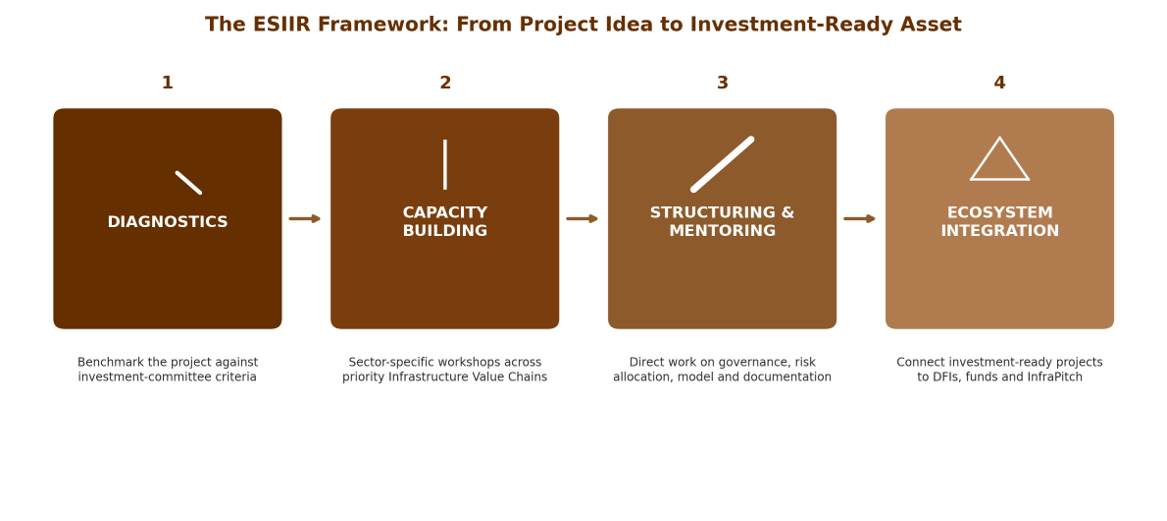
Element One: Diagonistics
Before any structuring work begins, every participating project is assessed against the same criteria an investment committee would actually apply: sponsor capability, commercial structure, risk allocation, financial model integrity, and documentation completeness. This diagnostic is conducted alongside advisers who have sat on the other side of the table in real infrastructure transactions – evaluating deals, not only structuring them – which gives the assessment a degree of rigor that a sponsor’s own internal review, however honest, is structurally unable to replicate.
The purpose of this stage is to establish precisely where a specific project’s gaps sit, rather than proceeding on assumption. It is not unusual for a diagnostic to surface issues a sponsor had not identified as issues at all – a verbal offtake understanding with no binding instrument behind it, a financial model that has never been stress-tested against currency risk, a governance structure with no independent oversight. None of this is presented as a verdict on the underlying project. It is the necessary starting point for everything that follows, because structuring work applied to the wrong diagnosis wastes the scarce time a project has before its next real investor conversation.
Element Two: Sector-Specific Capacity Building
The second element is delivered through a mix of virtual and in-person workshops, organised around the priority Infrastructure Value Chains ESIIR works across. This is deliberately not generic content. The commercial, regulatory and financing dynamics that govern a mid-scale power project are materially different from those governing a pre-development mining asset, a healthcare infrastructure project, or a gas commercialisation venture – the offtake structures differ, the relevant regulatory bodies differ, the typical financing instruments differ, and the risk allocation logic that applies to one sector often does not transfer cleanly to another.
Sessions are built around these sector-specific realities, drawing on the practical experience of advisers and, where relevant, investors and DFI representatives who work directly in each value chain. The objective is not general project finance literacy for its own sake, but knowledge a sponsor can apply immediately to the specific commercial and regulatory environment their own project operates within.
Element Three: Mentoring and Structuring.
The third element is where the diagnostic findings and sector knowledge from the first two elements are applied directly to each sponsor’s actual project, rather than to a hypothetical case study or generic template. This is the most resource-intensive part of the programme, and in our experience the part that produces the most measurable change in a project’s readiness.
In practice, this involves refining governance structures to address the concerns an institutional investor would raise; stress-testing financial models against the standards a lender’s technical adviser would apply, rather than the standards that satisfy a sponsor’s own equity return expectations; mapping and contractually addressing risk allocation gaps identified during diagnostics; and restructuring the investment memorandum and supporting documentation into the sequence and standard investors actually expect to receive it in – sponsor and governance first, commercial structure second, risk allocation third, financial case fourth.
This work is delivered through direct mentoring from advisers with relevant transaction experience, applied specifically to the sponsor’s own project rather than delivered as generic instruction. The goal at the end of this element is not a sponsor who understands project finance theory better – though that is a natural byproduct – but a project whose structure, governance and documentation have measurably closed the gaps a real investment committee would otherwise identify independently.
Element Four: Ecosystem Integration
The fourth element addresses a risk that is easy to overlook: that a project can become genuinely investment-ready and still fail to connect with the capital that would fund it, simply for lack of access to the right relationships at the right time.
ESIIR deliberately connects participating sponsors, over the course of the programme, with the investors, DFIs, family offices and advisers who make up the broader TAC ecosystem – including through platforms such as InfraPitch, where investment-ready projects are presented directly to a curated investor audience, and through the ongoing network of relationships built across TAC’s events, roundtables and conferences. Investment readiness that never meets capital is, in our view, only half the outcome worth aiming for. The fourth element is designed to ensure the other half – the connection itself – is not left to chance.
Why the Order Matters
It would be possible, in principle, to offer these four elements independently, as separate services a sponsor could select from individually. We have found, in practice, that this substantially reduces their effectiveness, because each element depends on what precedes it.
Diagnostics without structuring support tells a sponsor precisely what is wrong with their project, without providing the means to fix it – useful as a mirror, but incomplete as an intervention. Sector-specific workshops, delivered without direct application to a sponsor’s own project, produce generalised knowledge that sponsors frequently struggle to translate into a stronger investment memorandum or a better-structured risk allocation matrix for their specific circumstances. Structuring support, offered without the ecosystem access described in the fourth element, can produce a genuinely well-prepared project that nonetheless has nowhere immediate to take that readiness.
The combination – diagnosis, followed by sector-specific knowledge, followed by direct application to the sponsor’s own project, followed by connection to the investors positioned to act – is what we have found actually moves a project meaningfully within a defined timeline, rather than incrementally over years of informal, self-directed effort.
Who Is ESIIR Built For
ESIIR is designed for sponsors with a real, identifiable project – not a concept at the earliest stage of an idea, and not a project that has already reached financial close and requires no further readiness work. The typical participant has secured, or is close to securing, a site and initial regulatory standing; has done meaningful feasibility or technical work; and has begun, but not completed, the process of engaging investors or financiers.
This includes CEOs and founders of infrastructure and industrial ventures, project sponsors and developers across the priority value chains, public sector agencies advancing infrastructure projects that require private capital participation, and project development companies and EPC firms structuring their own or client projects for investment. What unites eligible participants is not sector or organisational type, but stage: a project mature enough to benefit meaningfully from structured readiness work, and not yet so far advanced that the window for that work has closed.
For sponsors uncertain whether their project is at the right stage for this kind of intervention, that judgment is itself one of the more useful conversations to have early – before committing significant additional time and resources to a financing process that structural gaps may otherwise cause to stall.
Key Takeaways
- ESIIR is built around four sequenced elements: diagnostics, sector-specific capacity building, direct transaction structuring support, and ecosystem integration.
- The programme addresses real, live sponsor projects – not hypothetical case studies – across priority Infrastructure Value Chains.
- Ecosystem access, including platforms like InfraPitch, connects investment-ready projects directly to curated investor audiences.
Keep reading Knowledge Hub
Related insights
Insights
Why Projects Fail Before Financing
The distance between a compelling infrastructure project and a bankable one – and why it decides almost everything that follows Across the infrastructure sector in Africa, a particular kind…
27 Jul 2026 · 11 min read
Insights
From Stalled to Structured
A hypothetical case study illustrating how the ESIIR framework converts an unexplained stalled financing process into structured addressable path to investment readiness. The Project Kestrel Power Partners is…
27 Jul 2026 · 10 min read
Insights
How Investors Evaluate Early-Stage Infrastructure Projects
A practical walk-through of the five filters development finance institutions and infrastructure investors apply – and the questions each one raises about your project. Most sponsors, preparing to approach an…
27 Jul 2026 · 11 min read
Insights
The Real Cost of Infrastructure Investment Delay
Why treating investment readiness as a later-stage formality is rarely the neutral, low-risk choice it feels like at the time. “We’ll tighten up the governance and the financial model…
27 Jul 2026 · 8 min read