
Developing and Financing Infrastructure Projects Cohort 7
The Developing & Financing Infrastructure Projects Course is designed for Aspiring Infraprenuers and Career Professionals seeking to improve their project finance…
- 13 October 2025
- Virtual
Organised by:
Co-Hosted by:

Dates and Mode of Delivery
Aug - Sept 2025 Virtual
5 Weeks
Intensive
Training
Programme Overview
The Developing & Financing Infrastructure Projects Course is designed for Aspiring Infraprenuers and Career Professionals seeking to improve their project finance knowledge and are involved in the Large Scale Infrastructure Projects.
Key Learning Outcomes
1. UNDERSTAND LIMITED RECOURSE FINANCING
Understand the fundamentals of Limited Recourse Finance based developments for the Private and Public Sector Projects.
2.UNDERSTAND WHAT MAKES PROJECTS BANKABLE
Appreciate the mechanisms that make projects bankable and investable as well as protects creditors
3. Understand Limited Resourse Financing
APPLY PROJECT RISK ANALYSIS WITH CASE STUDIES
Understand how to analyse and interpret risk to determine their severity and potential impact on the transaction structure.
Developing Financing Infrastructure Projects (DFIP) is organized by The African Catalyst and is focused on addressing the challenges and opportunities in financing infrastructure projects in Africa through education. It unites industry experts, policymakers, and stakeholders to explore innovative solutions for bridging the continent's infrastructure financing gap.
DFIP provides participants with practical knowledge on structuring bankable projects, covering themes like financial modeling, stakeholder engagement, and international funding.
Recap: Live Sessions 1 & 2
Introductory Remarks on the Developing and Financing Infrastructure Projects.
Our facilitator, Femi Awofala, brought the world of Project Finance in infrastructure development to life, making it relatable and engaging.
With a diverse mix of participants joining us from around the globe, including notable companies like Templars Law Firm, PwC, and KHS Capital, the atmosphere was buzzing with enthusiasm.
The sessions were a comprehensive journey, touching on fundamental project finance concepts, risk allocation, Public-Private Partnerships (PPP), early development stages in infrastructure deals, and the crucial pre-financing stage. Not to forget, the insightful Brickstone Project Bankability framework, which illuminated the path to ensuring project success from ideation to completion.
Overview of Project Finance, as a methodology designed by bankers to mobilise
Large Debt for Infrastructure Projects.
Our esteemed Course Director, Femi Awofala, Founder of Brickstone Africa and CEO of TheAfricanCatalyst has taken the stage to share his wealth of knowledge with our captive audience.
Today, he delves deep into the world of project finance, enlightening our participants about its intricate and essential concepts. From defining project finance to exploring its various facets, he covers topics like:
- What is project finance?
- Participants in a project finance deal
- Merits & demerits of project finance deals
- Principles of risk allocation
- The contractual nature of project finance
- Project finance development phases
- Types of financed projects
Join us for this enriching learning experience and gain valuable insights into the world of infrastructure entrepreneurship.
Mozal is a $1.4 billion, 250,000-ton, largescale aluminum smelter project in Mozambique
The sessions focus on the Early Development Stage, the first stage of the Project's Development Process.
After a refreshing tea break, Femi Awofala, a distinguished Private Sector Infrastructure Consultant, joined us virtually. With expertise in the field, he provided valuable insights into the early development stage of project finance infrastructure deals.
During his engaging session, he covered a wide array of topics, including:
An overview of Public Private Partnerships (PPP)
The solicitation process through International Competitive Bidding (ICB) and its key activities
The importance of private sector participation
Conducting competitive bidding effectively
The role of RFP (Bid Document Package)
The meticulous process of Bidder Final Selection
The significance of unsolicited proposals
Considerations in signing PPP contracts
Join us as we continue to explore the intricate world of infrastructure entrepreneurship and project finance.
The Dabhol project is a 2,015 MW, $2.8 billion gas-fired power plant located in India’s Maharashtra State.
Understanding the Pre-Financing Stage.
After a satisfying 1-hour lunch break, our Course Director, Femi Awofala, returns to the stage, this time with a fascinating practical case study - the Dabhol Power Project.
In these sessions, he also takes us through the nitty gritty of the pre-financing stage in a project finance infrastructure deal, shedding light on vital elements and key activities involved, including the intricate financial models.
To truly grasp the concept of 'Bankability' in project development, Femi introduces the Brickstone Bankability Framework, a creation of Brickstone Africa. He expounds on the significance of project bankability, focusing on aspects such as predictable cash flow, optimal construction and operations, as well as the critical factors of good governance and sustainability.
CLICK TO WATCH
Join us as we continue to explore the intricate world of infrastructure entrepreneurship and project finance. 🌍💼
Recap: InfraPITCH Session Group A
Case Study of the Baynes Hydropower Project
The Baynes Hydropower Project, a cross-border initiative between Angola and Namibia, is designed to harness the Kunene River’s potential to generate reliable renewable electricity. Envisioned as a large-scale hydroelectric dam, the project aims to supply over 600 MW of capacity, supporting domestic demand in both countries and contributing to the Southern African Power Pool (SAPP).
Recap: Live Sessions 3 & 4
Recap: InfraPITCH Session Group B
Case Study of the East African Corridor Rail Operator
This project explored the development of a regional rail operator to strengthen trade and connectivity along the East African Corridor. The proposal aimed to improve the efficiency of cargo transport across Kenya, Uganda, Rwanda, and potentially the Democratic Republic of Congo by upgrading rolling stock, operations, and management of the standard gauge and meter-gauge railways.
Pitch Highlights
The presenter emphasized the inefficiencies of road-based logistics, where high transport costs erode competitiveness of East African exports. By consolidating operations under a professional regional operator, the project aimed to lower costs, reduce road congestion, and boost regional trade. The business model leaned on long-term freight contracts with mining, agriculture, and manufacturing companies.
Pitch Highlights
The presenter positioned Baynes as a cornerstone of regional cooperation. The project was framed not just as an energy supply venture, but also as an enabler of industrial growth, rural electrification, and climate-friendly development. The financing concept included a joint development authority, with costs and benefits shared between Angola and Namibia. Revenue was expected from long-term power purchase agreements (PPAs) with both national utilities.
Recap: Live Sessions 5 & 6
Recap: InfraPITCH Session Group C
Case Study of the Expansion of Beira Port
The Beira Port expansion project in Mozambique was pitched as a critical upgrade to one of Southern Africa’s most strategic gateways. Serving landlocked countries such as Zimbabwe, Zambia, and Malawi, Beira Port’s expansion aimed to increase capacity, modernize facilities, and enhance efficiency for bulk commodities and container traffic.
Pitch Highlights
The presenter positioned Beira as a cost-saving alternative to congested South African ports. Proposed investments included deepening berths, upgrading cargo handling equipment, and digitalizing customs processes. The revenue model relied on increased throughput, concessions, and long-term contracts with shipping lines and bulk exporters.
Recap: Live Sessions 7 & 8
Recap: Live Sessions 9 & 10
Recap: Live Sessions 11 & 12
Recap: InfraPITCH Session Group D
Case Study of the East African Green Power Transmission Project
This project proposed the construction of a cross-border transmission network, designed to carry renewable electricity — particularly from Ethiopia’s Grand Ethiopian Renaissance Dam (GERD) — to neighboring countries including Kenya, Tanzania, Uganda, and potentially beyond. The system envisioned over 1,300 km of high-voltage lines capable of delivering up to 3,000 MW of clean energy.
Pitch Highlights
The presenter framed the project as both climate-smart and economically strategic. It would enable countries to diversify their energy mix, reduce reliance on fossil fuels, and access affordable electricity. The transmission system would integrate into the Eastern Africa Power Pool (EAPP), fostering regional energy trade. The financial structure leaned on long-term wheeling agreements and intergovernmental treaties.
Judges’ Feedback
Judges acknowledged the transformative potential but raised critical points:
Political risk: Cross-border energy projects depend on multi-country cooperation and long-term stability in relations.
Regulatory harmonization: Tariff structures, wheeling charges, and legal frameworks differ across countries and need alignment.
Construction and delivery risk: Judges noted that such mega-projects often face delays, cost overruns, and land acquisition challenges.
Takeaway
The transmission project showcased how regional power integration can unlock renewable potential, but requires political stability, harmonized regulation, and disciplined project management to reassure financiers.
Africa Infrapreneurs Programme spirit from
Past events
DFIP 07
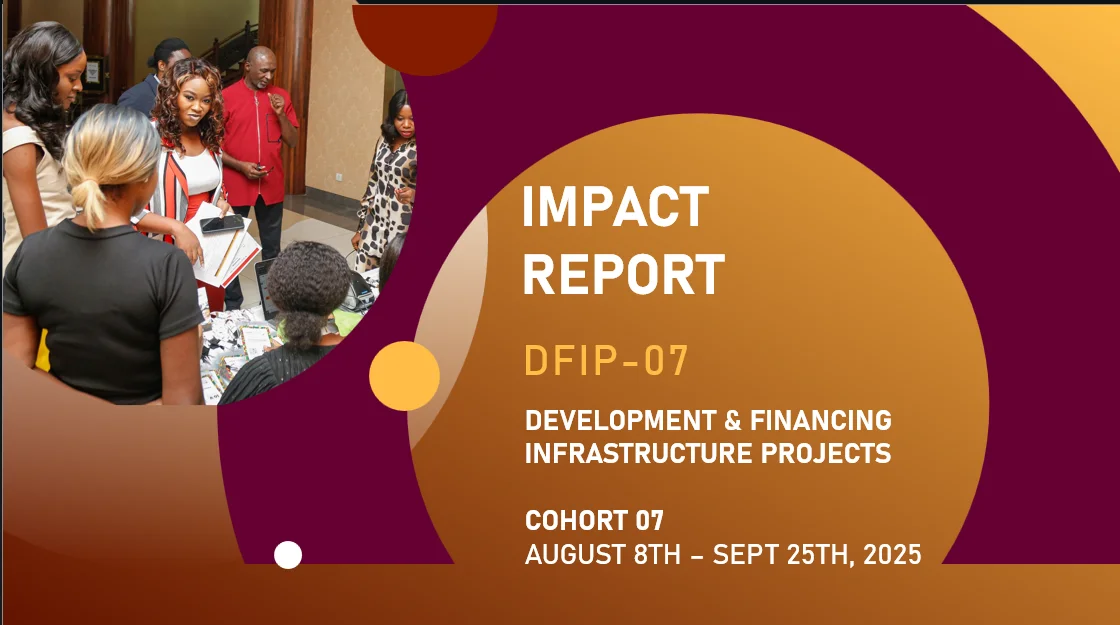
The Developing and Financing Infrastructure Programme (DFIP-07) Impact Report provides a comprehensive overview of the outcomes, achievements, and ecosystem impact generated through the eighth cohort of the programme.
The report highlights how DFIP-07 strengthened the capacity of infrastructure stakeholders, accelerated project development readiness, facilitated investment and partnership opportunities, and deepened knowledge transfer across the African infrastructure landscape.
It captures key programme milestones, participant engagement metrics, institutional collaborations, project pipeline development, financing outcomes, and testimonials from industry leaders and participants.
CLICK ON IMAGE >>>>>