
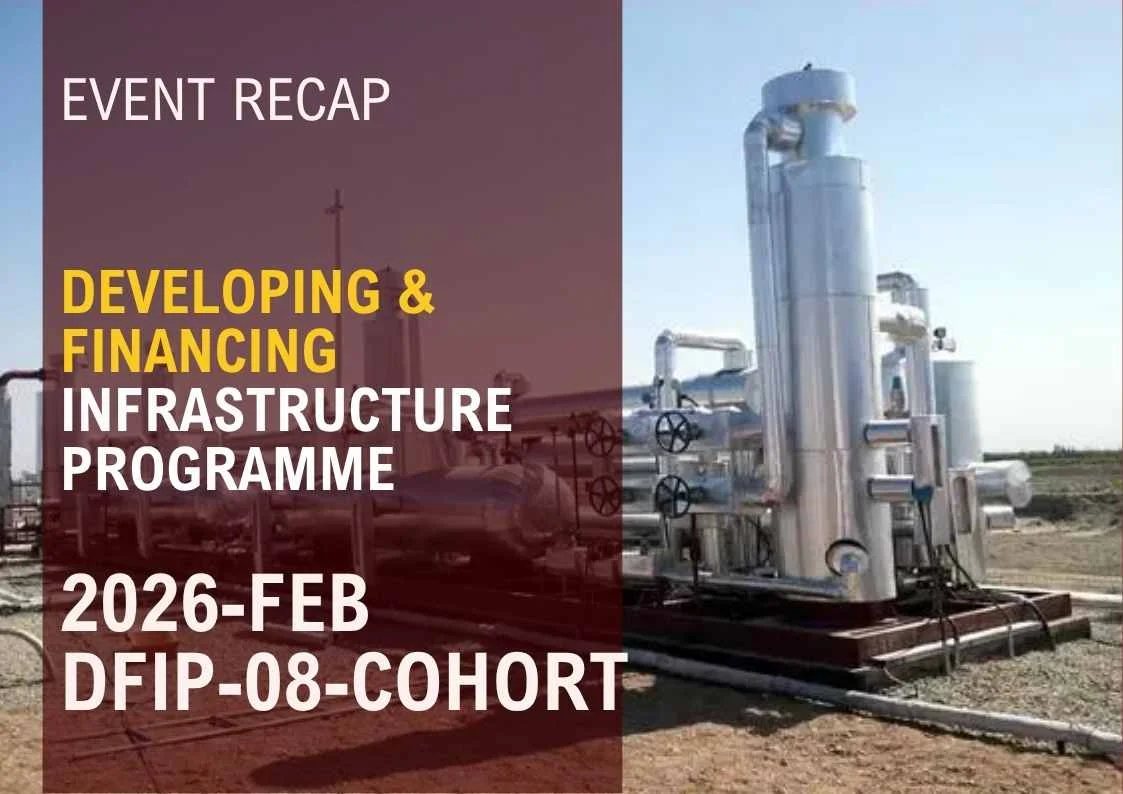
Developing and Financing Infrastructure Programme | Cohort 8
OVERVIEW COURSE VIDEO LIVE SESSION TESTIMONIALS FAQ Programme Overview The Developing & Financing Infrastructure Programme Course is designed for Aspiring Infraprenuers and Career Professionals seeking to improve their project finance…
- 30 March 2026
- Virtual
Organised by:

Co-Hosted by:

Dates and Mode of Delivery
Feb - Mar 2026 Virtual
5 Weeks
Intensive
Training
Programme Overview
The Developing & Financing Infrastructure Programme Course is designed for Aspiring Infraprenuers and Career Professionals seeking to improve their project finance knowledge and are involved in the Large Scale Infrastructure Projects.
Key Learning Outcomes
1. UNDERSTAND LIMITED RECOURSE FINANCING
Understand the fundamentals of Limited Recourse Finance based developments for the Private and Public Sector Projects.
2.UNDERSTAND WHAT MAKES PROJECTS BANKABLE
Appreciate the mechanisms that make projects bankable and investable as well as protects creditors
3. UNDERSTAND LIMITED RESOURCE FINANCING
APPLY PROJECT RISK ANALYSIS WITH CASE STUDIES
Understand how to analyse and interpret risk to determine their severity and potential impact on the transaction structure.
Developing Financing Infrastructure Projects (DFIP) is organized by The African Catalyst and is focused on addressing the challenges and opportunities in financing infrastructure projects in Africa through education. It unites industry experts, policymakers, and stakeholders to explore innovative solutions for bridging the continent's infrastructure financing gap.
DFIP provides participants with practical knowledge on structuring bankable projects, covering themes like financial modeling, stakeholder engagement, and international funding.
Recap: Live Sessions 1 & 2
Introductory Remarks on the Developing and Financing Infrastructure Projects.
Our facilitator, Femi Awofala, brought the world of Project Finance in infrastructure development to life, making it relatable and engaging.
With a diverse mix of participants joining us from around the globe, including notable companies like Templars Law Firm, PwC, and KHS Capital, the atmosphere was buzzing with enthusiasm.
The sessions were a comprehensive journey, touching on fundamental project finance concepts, risk allocation, Public-Private Partnerships (PPP), early development stages in infrastructure deals, and the crucial pre-financing stage. Not to forget, the insightful Brickstone Project Bankability framework, which illuminated the path to ensuring project success from ideation to completion.
Overview of Project Finance, as a methodology designed by bankers to mobilise
Large Debt for Infrastructure Projects.
Our esteemed Course Director, Femi Awofala, Founder of Brickstone Africa and CEO of TheAfricanCatalyst has taken the stage to share his wealth of knowledge with our captive audience.
Today, he delves deep into the world of project finance, enlightening our participants about its intricate and essential concepts. From defining project finance to exploring its various facets, he covers topics like:
- What is project finance?
- Participants in a project finance deal
- Merits & demerits of project finance deals
- Principles of risk allocation
- The contractual nature of project finance
- Project finance development phases
- Types of financed projects
Join us for this enriching learning experience and gain valuable insights into the world of infrastructure entrepreneurship.
Mozal is a $1.4 billion, 250,000-ton, largescale aluminum smelter project in Mozambique
The sessions focus on the Early Development Stage, the first stage of the Project's Development Process.
After a refreshing tea break, Femi Awofala, a distinguished Private Sector Infrastructure Consultant, joined us virtually. With expertise in the field, he provided valuable insights into the early development stage of project finance infrastructure deals.
During his engaging session, he covered a wide array of topics, including:
An overview of Public Private Partnerships (PPP)
The solicitation process through International Competitive Bidding (ICB) and its key activities
The importance of private sector participation
Conducting competitive bidding effectively
The role of RFP (Bid Document Package)
The meticulous process of Bidder Final Selection
The significance of unsolicited proposals
Considerations in signing PPP contracts
Join us as we continue to explore the intricate world of infrastructure entrepreneurship and project finance.
The Dabhol project is a 2,015 MW, $2.8 billion gas-fired power plant located in India’s Maharashtra State.
Understanding the Pre-Financing Stage.
After a satisfying 1-hour lunch break, our Course Director, Femi Awofala, returns to the stage, this time with a fascinating practical case study - the Dabhol Power Project.
In these sessions, he also takes us through the nitty gritty of the pre-financing stage in a project finance infrastructure deal, shedding light on vital elements and key activities involved, including the intricate financial models.
To truly grasp the concept of 'Bankability' in project development, Femi introduces the Brickstone Bankability Framework, a creation of Brickstone Africa. He expounds on the significance of project bankability, focusing on aspects such as predictable cash flow, optimal construction and operations, as well as the critical factors of good governance and sustainability.
CLICK TO WATCH
Join us as we continue to explore the intricate world of infrastructure entrepreneurship and project finance. 🌍💼
Recap: InfraPITCH Session Group A
Atlantic Link West Africa Submarine Fiber Cable Project
Victory Isiguzo presented the Atlantic Link West Africa Submarine Fibre Cable Project, a digital infrastructure initiative designed to address what the World Bank estimates to be approximately 40% internet penetration across Africa. The project proposed branching an existing transoceanic cable — currently connecting Europe and Brazil, with landing points in Mauritania and Cape Verde — to serve five West African countries currently underserved by digital connectivity. The project would involve approximately 7,000 kilometres of new submarine cable with four fibre pairs, estimated at a total cost of $1.5 billion. The project aligned with the African Union's digital agenda and ECOWAS connectivity frameworks.
Jury Feedback
Shaheed Ali acknowledged the quality of the presentation and the team's identification of key project finance elements. He urged the presenters to go deeper on market analysis — particularly the distinction between the wholesale cable market, the landing station market, and the consumer market — and to ensure revenue-based diversity. He drew on his institution's own experience financing an undersea cable, noting that a detailed understanding of the market layers is essential to a credible financial model.
Taiwo Olatunji flagged a structural concern: the grouping of equity investors and project sponsors under one category. He advised that for transactions of this nature, there should be one or two clear project sponsors driving the initiative, with other equity investors in supporting roles. He also noted that the Atlantic Link is an existing infrastructure asset and that engagement with the existing company operating it would likely be necessary.
Recap: Live Sessions 3 & 4
Recap: InfraPITCH Session Group B
The Lome-Lagos Corridor Highway (LLCH) Project
This project explored the development of a regional rail operator to strengthen trade and connectivity along the East African Corridor. The proposal aimed to improve the efficiency of cargo transport across Kenya, Uganda, Rwanda, and potentially the Democratic Republic of Congo by upgrading rolling stock, operations, and management of the standard gauge and meter-gauge railways.
Pitch Highlights
The presenter emphasized the inefficiencies of road-based logistics, where high transport costs erode competitiveness of East African exports. By consolidating operations under a professional regional operator, the project aimed to lower costs, reduce road congestion, and boost regional trade. The business model leaned on long-term freight contracts with mining, agriculture, and manufacturing companies.
Pitch Highlights
The presenter positioned Baynes as a cornerstone of regional cooperation. The project was framed not just as an energy supply venture, but also as an enabler of industrial growth, rural electrification, and climate-friendly development. The financing concept included a joint development authority, with costs and benefits shared between Angola and Namibia. Revenue was expected from long-term power purchase agreements (PPAs) with both national utilities.
Recap: Live Sessions 5 & 6
Recap: InfraPITCH Session Group C
Lesotho-Botswana Water Transfer (L-BWT) Project
Muhammad Saad Umar presented a transboundary water infrastructure project addressing a severe and growing water deficit across three Southern African nations. The project proposed a 124-metre concrete arch dam on the Makhaleng River in Lesotho, combined with a 700-kilometre pipeline delivering water to Botswana (150 million cubic metres per year), Lesotho (97 million cubic metres), and South Africa (63 million cubic metres). In the long run, the project would integrate a 35–45 MW hydropower component to reduce Lesotho's significant electricity import dependency. The project is a designated priority under the NEPAD Programme for Infrastructure Development in Africa (PIDA) and already has an existing Memorandum of Agreement from 2013 between the three sovereign states. Total project CapEx was estimated at $2.5 billion, with a preparation funding gap of $3.2 million.
Jury Feedback
Shaheed Ali commended the presentation and the quality of the financial ratios. However, he asked the team to clarify the project's primary identity — water or power — noting that the hydropower component, while significant, appeared to sit somewhat awkwardly alongside the water transfer focus. More critically, he asked the team to interrogate the project's 100% dependence on government off-take: under a take-or-pay structure, all risk effectively sits with the sovereign parties, and the team needed to assess whether the governments of Botswana, Lesotho, and South Africa could genuinely afford the implied financial obligations.
Muhammad Saad Umar responded by clarifying that the project is primarily a water project, with hydropower intended as a long-run enhancement rather than a core commercial stream. He acknowledged the government dependency and noted that PPP arrangements with utility management operators would be pursued before final deal structures are signed.
Recap: Live Sessions 7 & 8
Recap: Live Sessions 9 & 10
Recap: Live Sessions 11 & 12
Recap: InfraPITCH Session Group D
Luapula Hydropower Project
Chibuzor Happiness Obi presented the Luapula Hydropower Project, a 789 MW cross-border hydropower development on the Luapula River, spanning the Democratic Republic of Congo and Zambia. The project was designed to address severe energy deficits constraining economic growth in both countries, including over 12 hours of daily load shedding in Zambia and an electrification rate of just 19% in the DRC. The project would deliver clean energy to mining operations, regional utilities, and the South African Power Pool. The capital structure comprised $504 million in equity and $1.176 billion in senior debt, at a total CapEx of $1.68 billion. Off-take would be secured through 20-25 year PPAs with ZESCO and SNEL (80% capacity) and the Copperbelt Energy Corporation (20%), with surplus capacity sold on the SAPP spot market.
The project's financial model projected a 12.54% project IRR, a 37.09% return on equity, and a DSCR of 2.98 — well above the 1.5x typically required by DFI lenders. The $3 million seed equity request would fund hydrological and climate assessments, feasibility and preliminary engineering, environmental and social impact assessments, legal structuring, and financial advisory.
Jury Feedback
Shaheed Ali praised the depth of the presentation and noted that the key elements of project finance structuring were identifiable. He raised two substantive concerns. First, climate risk: traditional hydrological forecasting based on historical weather data is no longer reliable in the current climate change environment, and the team must demonstrate how they would address this when presenting to commercial lenders and DFIs. Second, he reiterated the government off-take concentration risk — with approximately 80% of revenue dependent on sovereign entities, the team needs to demonstrate that the governments of Zambia and the DRC can absorb these obligations, and that dollar availability and transferability have been specifically modelled.
Africa Infrapreneurs Programme spirit from
Past events
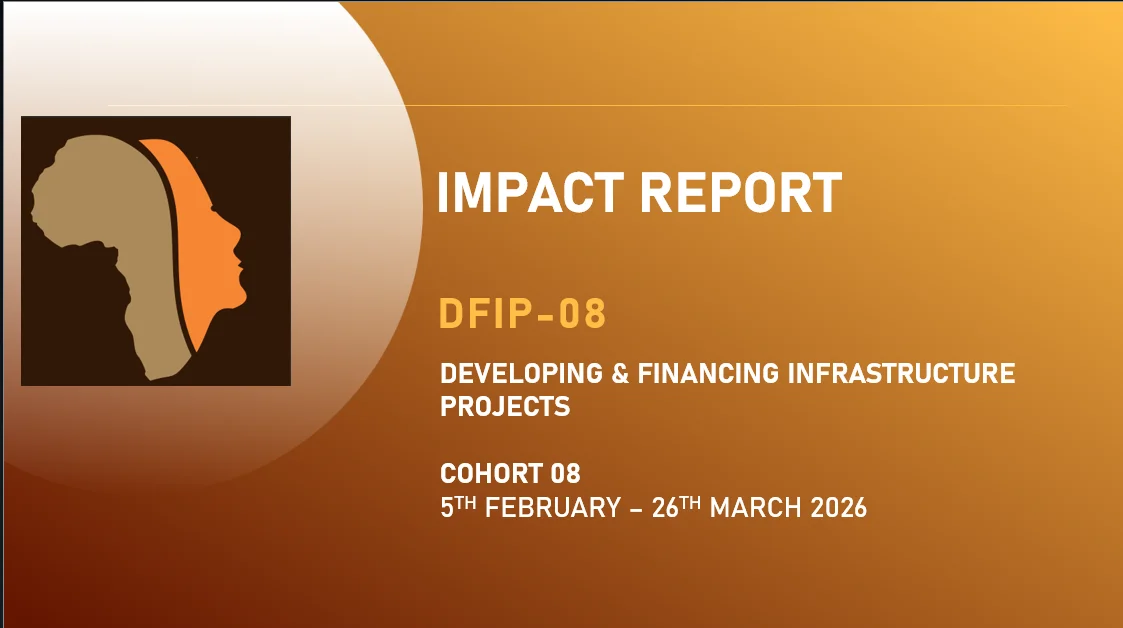
DFIP-08 Impact Report
The Developing and Financing Infrastructure Programme (DFIP-08) Impact Report provides a comprehensive overview of the outcomes, achievements, and ecosystem impact generated through the eighth cohort of the programme.
The report highlights how DFIP-08 strengthened the capacity of infrastructure stakeholders, accelerated project development readiness, facilitated investment and partnership opportunities, and deepened knowledge transfer across the African infrastructure landscape.
It captures key programme milestones, participant engagement metrics, institutional collaborations, project pipeline development, financing outcomes, and testimonials from industry leaders and participants.
CLICK ON IMAGE >>>>>