

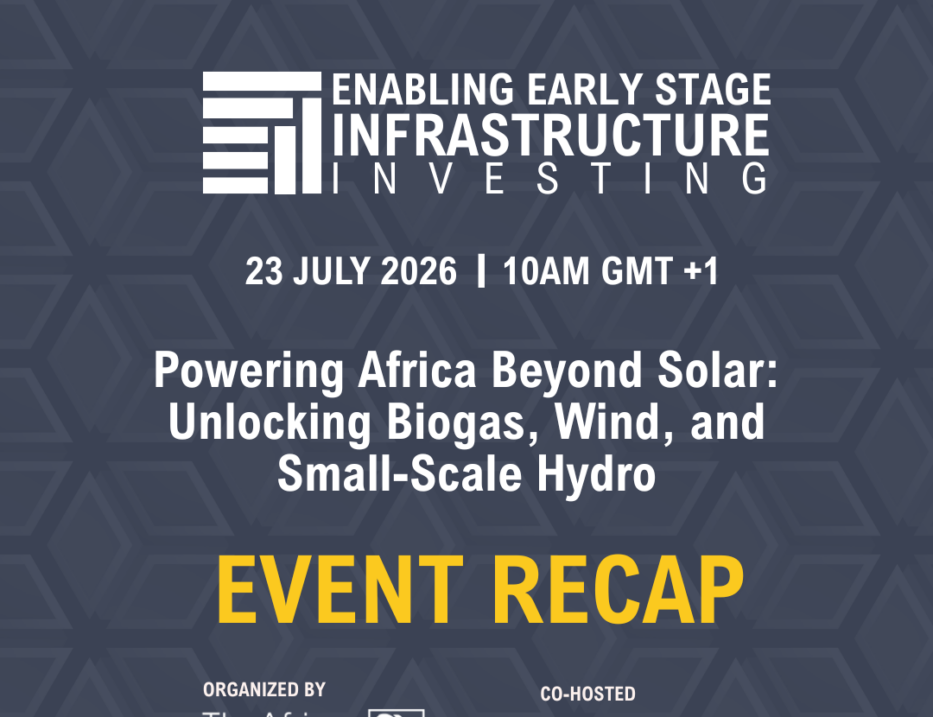
Enabling Early Stage Infrastructure Investing | 3.0
The Enabling Early Stage Infrastructure Investing is an Ecosystem Roundtable focused on the Opportunities, Issues and Constraints affecting Early Stage Investing in Infrastructure in Africa
- 23 July 2026
Organized by:
Co-Hosted by:

Sponsored by:

Media Partner

Endorsed by:
EESII-3.0 (Enabling Early Stage Infrastructure Investing), hosted by The African Catalyst in partnership with Brickstone Africa, sponsored by Kenna Partners, supported by Nigeria Wind Energy Council, and media partnership by The Business Year brought together key stakeholders in Africa’s infrastructure ecosystem — from developers and financiers to policy advisors and enablers.
The event addressed the continent’s early-stage project development challenges through expert panel discussions, the DFIP InfraPitch competition, and structured engagements.
By combining thought leadership with practical case studies, EESII-3.0 created a platform to bridge the gap between promising infrastructure ideas and the investment readiness required to secure funding.
Destiny Donald-Igwe - Corporate Development and Compliance, The African Catalyst
Femi Awofal – Founder of The African Catalyst (Moderator)
Nimma Jo-Madugu – Partner, Kenna Partners.
Ahmad Damcida - CEO, Energy Culture Limited
Ojodomo Odiniya -Research & Operations Consultant at the Nigeria Wind Energy Council
Patrick Mwangi – East Africa Regional Manager at Camco
Dr. Gori Olushina Daniel-Managing Partner at AP3 Advisory
- Erabor Okogun - Managing Director at The Infrastructure Bank
Jurors:
- Shaheed Alli, Head-Project Preparation, Development Bank of Southern Africa
- Femi Awofala, Founder of The African Catalyst
- Kareen Njounkwe, Project Preparation Professional
- Ahmed Damcida, Chief Executive Officer at Energy Culture Limited
- Nafal Hassani-Mohamed, Manager, Project Preparation at African Export-Import Bank
Presented Projects and Developers:
- Lesotho Highland Water Project (Phase II) - Victory Igweh & Testimony Olateju.
- LAPSSET Crude Oil Pipeline Project - Itunu Adewole.
- LAPSSET Railway Project - Oyebanji Fatai
- Trans-Sahara Optic Fibre Project - Taiwo Odusanya
Femi Awofala - Founder, The African Catalyst
Session Highlights
The third edition of the Enabling Early-Stage Infrastructure Investing Series (EESII 3.0) brought together investors, developers, legal practitioners, policymakers, and early-stage project sponsors from across Africa and beyond. Over the course of a full-day virtual programme, the event examined the practical mechanics of moving infrastructure projects from concept to bankability — through expert dialogue, a landmark diversified energy mix panel discussion and live project pitches from the ninth cohort of the Developing and Financing Infrastructure Programme (DFIP-9).
Introduction & Welcome Remarks
The third edition of the Enabling Early-Stage Infrastructure Investing Series (EESII) opened with host Chisom Osunwa welcoming participants to a session built around one persistent gap in Africa's infrastructure journey: the early stage — the point where a promising concept still has to become a bankable project.
The event was convened by The African Catalyst, co-hosted by Brickstone Africa, and supported by Kenna Partners as sponsor, the Nigeria Wind Energy Council as endorsement partner, and The Business Year as media partner.
This edition's theme, "Powering Africa Beyond Solar: Unlocking Biogas, Wind, and Small-Scale Hydro," set the tone for the day. While solar has driven much of the continent's recent progress on energy access, the day's conversations pushed toward a broader, more resilient energy mix — one that leans on biogas, wind, and small-scale hydropower to strengthen energy security and diversify Africa's path to sustainable development.
The programme for the day combined panel discussion, live project pitches, and direct insight from speakers, panellists, and jurors — all oriented around a practical question: what does it actually take to move an infrastructure project from idea to investment-ready?
Welcome Remarks — Destiny Donald-Igwe - Corporate Development and Compliance, the African Catalyst
Ms Destiny Donald-Igwe, Corporate Development and Compliance at The African Catalyst, delivered the event's opening remarks, commending Mr Femi Awofala and his team for building a platform that continues to shape critical conversations on Africa's infrastructure and investment future.
She framed the day's theme as a reflection of an important reality: solar has transformed electricity access across the continent, but Africa's clean energy future needs to be broader and more diversified. Biogas, wind, and small-scale hydropower represent real opportunities to strengthen energy security — but unlocking them takes more than abundant natural resources. It requires a strong pipeline of investment-ready projects, since too many promising ideas fail to attract financing due to a lack of technical preparation and early-stage readiness.
She highlighted the day's two central sessions — the Panel Session, featuring public and private sector experts discussing Africa's infrastructure development, and the InfraPITCH Session, where group leads from Cohort 9 of the Developing and Financing Infrastructure Projects (DFIP) programme presented their projects for feedback.
Her closing message centred on collaboration: Africa's infrastructure challenge cannot be solved by governments or the private sector alone — it demands shared commitment to projects that are commercially viable, socially impactful, and sustainable. She closed by urging attendees to move from identifying challenges to building solutions, and wished the audience a productive and impactful EESII 3.0.
POWERING AFRICA BEYOND SOLAR: UNLOCKING BIO-GAS, WIND, AND SMALL-SCALE HYDRO PANEL SESSION
The panel session brought together renewable energy and infrastructure finance experts to discuss the opportunities, obstacles, and practical steps for scaling biogas, wind, and small-scale hydro within early-stage infrastructure projects — looking past solar to the fuller range of clean energy options available across the continent.
The conversation was moderated by Mr Femi Awofala, Founder of The African Catalyst, with a panel comprising:
Nimma Jo-Madugu, Partner at Kenna Partners — project financing and capital markets specialist who has led transactions including one of Nigeria's largest infrastructure funds and a NGN 500 billion REIT.
Ojodomo Odiniya, Research & Operations Consultant, Nigeria Wind Energy Council — a COREN-registered engineer leading renewable energy research, policy, and stakeholder engagement for wind development in Nigeria.
Patrick Mwangi, East Africa Regional Manager, Camco — climate finance and project development professional leading origination and portfolio management for the USD 250 million REPP 2 Fund.
Dr. Gori Olushina Daniel, Managing Partner, AP3 Advisory — Transaction Advisor with 25+ years across PPP policy and infrastructure finance, having contributed to raising over $120 billion for large-scale infrastructure and serving as Senior Advisor for PPP at the African Development Bank Group.
Erabor Okogun, Managing Director, The Infrastructure Bank — infrastructure finance expert with two decades of experience across energy and project finance, backed by transactions with the World Bank Group, AFC, and FMO.
Ahmad Damcida, CEO, Energy Culture Limited — project development professional with nearly 20 years across energy, mining, transportation, and project finance.
INFRAPITCH SESSION – DFIP 09 PROJECT PRESENTATIONS
The InfraPitch session is the cornerstone of the EESII series — the moment where early-stage infrastructure projects, developed over six intensive weeks by participants of the Developing and Financing Infrastructure Programme, are presented live to a panel of expert jurors for structured feedback and evaluation.
Jury Panel:
Shaheed Alli, Head-Project Preparation, Development Bank of Southern Africa
Femi Awofala, Founder of The African Catalyst
Kareen Njounkwe, Project Preparation Professional
Ahmed Damcida, Chief Executive Officer at Energy Culture Limited
Nafal Hassani-Mohamed, Manager, Project Preparation at African Export-Import Bank
Four groups from DFIP Cohort 9 presented projects spanning digital infrastructure, road transport, water security, and hydropower. Each group had 15 minutes to present, followed by jury feedback.
Lesotho Highlands Water Project — Phase II
Project Overview
One of Africa's flagship transboundary water infrastructure projects, developed jointly by Lesotho and South Africa. Phase II expands the existing scheme by increasing water transfer to South Africa while also supporting hydropower development and regional water security.
Jury Feedback
Shaheed Ali acknowledged the quality of the presentation and the team's identification of key project finance elements. He urged the presenters to go deeper on market analysis — particularly the distinction between the wholesale cable market, the landing station market, and the consumer market — and to ensure revenue-based diversity. He drew on his institution's own experience financing an undersea cable, noting that a detailed understanding of the market layers is essential to a credible financial model.
Taiwo Olatunji flagged a structural concern: the grouping of equity investors and project sponsors under one category. He advised that for transactions of this nature, there should be one or two clear project sponsors driving the initiative, with other equity investors in supporting roles. He also noted that the Atlantic Link is an existing infrastructure asset and that engagement with the existing company operating it would likely be necessary.
LAPSSET Crude Oil Pipeline Project
Project Overview
A proposed crude oil pipeline linking production in South Sudan (estimated at 150,000–180,000 barrels per day) and Kenya (estimated at 60,000–80,000 barrels per day), positioned within the wider LAPSSET Corridor. The project's risk mitigation strategy centres on MIGA political risk insurance and take-or-pay offtake arrangements.
Jury Feedback
he panel's response focused heavily on risk. Ahmad Damcida raised concerns about volumetric risk, noting that production forecasts from what remains a relatively frontier geological market may not hold, and that a take-or-pay structure offers limited protection if reduced flow triggers a force majeure declaration. He also flagged the build-up period — the lag before production ramps up to design capacity — as a cash flow risk that needs to be reflected in financing assumptions, and recommended the team look beyond MIGA to a Partial Risk Guarantee, given that neither South Sudan nor Kenya can independently provide sufficient sovereign cover for a project of this exposure. Kareen Njounkwe asked how the production assumptions were derived (the team cited feasibility research) and probed the project's exposure to security and political risk given the cross-border route — the team pointed to MIGA coverage and protective agreements against adverse government policy shifts as mitigants.
LAPSSET Railway Project
Project Overview
A $3 billion, 533-kilometre railway line running from the Lamu deep-sea port to Isiolo, Kenya — the first phase of a larger LAPSSET Corridor railway intended to eventually connect Kenya with Ethiopia and South Sudan. Designed for 25 million tonnes of freight annually and 12 million passenger journeys, at a design speed of 120 km/h. The project sponsor is Jibus Nigeria Limited (30% equity stake), delivered through an SPV, LAPSSET Railway Development Limited, with senior debt from development finance institutions and an EPC contractor to be selected via competitive bidding. Revenue is structured across freight, passenger, and intermodal logistics streams, with offtake agreements indexed to manage currency and forex volatility. The team is targeting financial close by Q4, following a phased path of concession signing, equity close, and due diligence/finance documentation. Projected IRR of 15.75%, valuing the project at $2.12 billion at close, with a $3 million seed funding request to complete feasibility and readiness studies.
Jury Feedback
Kareen Njounkwe opened with praise for the clarity of the presentation, noting it was easier to follow than prior pitches. Her substantive question centred on demand: given that Ethiopia has access to the Djibouti port and South Sudan continues to face instability, why should the route's demand case hold? The team responded by pointing to feasibility research (citing c. 267,000 in projected passenger/freight traffic) and framing the Lamu route as more cost-effective and a way to bypass the political risk associated with the Djibouti corridor. Kareen closed by cautioning — as she had with prior regional projects — that cross-border infrastructure is notoriously difficult to execute in practice, even where coordination frameworks look strong on paper, due to shifting political commitments across countries, and recommended the team strengthen this part of the deck.
Trans-Sahara Optic Fibre / Broadband Project
Project Overview
A submarine and terrestrial fibre infrastructure project sized at approximately $4.5 billion, delivered through an SPV, Trans-Sahara Broadband Infrastructure Limited. The project is structured on an open-access model, with indefeasible right-of-use (IRU) offtake agreements with telecom operators and internet service providers to de-risk revenue, and MIGA political risk insurance to cover cross-border exposure. Beneficiaries cited include telecom operators, ISPs, governments, businesses, SMEs, and an estimated 2 million+ people. Financial highlights included a projected IRR of 19.2% against an 18% discount rate — with the team noting project IRR exceeding the discount rate as their commercial viability case — and a $4.96 million seed funding request to cover legal and regulatory cross-border licensing, SPV setup, and contingency.
Jury Feedback
Kareen Njounkwe congratulated the team on a strong commercial and financing approach, but recommended strengthening the evidentiary base behind key assumptions — particularly around securing anchor customers and obtaining cross-border regulatory approvals, both of which "sound good on paper" but are challenging in execution. She also pressed on competitive positioning: given the project builds on existing infrastructure, what is the specific value-add, how does the team plan to work with (or around) a major competitor like Starlink, and which countries and sectors are expected to drive the traffic volumes the project depends on.
Closing the programme, Mr Femi Awofala, Founder of The African Catalyst, reflected on EESII reaching its third edition, noting it had "been a long time coming." He began to speak to one of the day's central threads — that early-stage infrastructure requires a different mindset from conventional infrastructure investing, and that pitching early-stage projects surfaces that difference clearly.
More Events at The African Catalyst
Related highlights
All Past Highlights
EESII26 March 2026
Enabling Early Stage Infrastructure Investing | 2.0
The Enabling Early Stage Infrastructure Investing is an Ecosystem Roundtable focused on the Opportunities, Issues and Constraints affecting Early Stage Investing in Infrastructure in Africa
- Investment Readiness
- Project Preparation
EESIISeptember 2025 (approx.)
Enabling Early Stage Infrastructure Investing | 1.0
The Enabling Early Stage Infrastructure Investing is an Ecosystem Roundtable focused on the Opportunities, Issues and Constraints…
- Investment Readiness
- Project Preparation